Throughout my more than a decade of professional experience, one of the questions I encounter most frequently is whether a client should purchase a single 2,000 kg-capacity freeze dryer or four 500 kg-capacity units. In this guide, I will draw upon past projects of similar scale and analyze key performance metrics to help you make an informed decision regarding the capacity of your freeze-drying equipment.
What “500 kg” and “2000 kg” mean on a spec sheet
Short answer: The rating is the fresh product loaded per batch. As a working rule, a 500 kg machine has about 50 m² of shelf area and a 2000 kg machine about 200 m², which assumes roughly 10 kg of fresh fruit per square metre of shelf.
That loading figure depends on how deep the product sits on the tray. Thicker pieces, purées and dense blends change it, so ask each supplier which loading density its rating assumes. Two machines both labelled “500 kg” can have noticeably different shelf areas.
| Class | Shelf area | Fresh fruit per batch | Typical buyer |
|---|---|---|---|
| 500 kg | ≈ 50 m² | ≈ 500 kg | Small food business, fruit snack start-up, plants with many SKUs |
| 1000 kg | ≈ 100 m² | ≈ 1,000 kg | Mid-size processor outgrowing a single small unit |
| 2000 kg | ≈ 200 m² | ≈ 2,000 kg | Large food enterprise with stable, high-volume products |
Procurement teams sometimes plan revenue as if 500 kg in meant 500 kg out. It does not, and the gap is large.
How much dried fruit does one batch produce?
Short answer: Between roughly 60 kg (strawberries) and 115 kg (bananas) per 500 kg batch, depending on the fruit.
Fresh fruit is mostly water, and the dryer removes nearly all of it. The table below uses water content for raw fruit from USDA FoodData Central and assumes 3% residual moisture in the finished product. Peeling, coring and trimming losses are not included.
| Fruit | Water content | Dried output per 500 kg batch | Ice the condenser must capture |
|---|---|---|---|
| Strawberry | 91% | ≈ 60kg | ≈ 440 kg |
| Peach | 89% | ≈ 70 kg | ≈ 430 kg |
| Apple | 86% | ≈ 85 kg | ≈ 415 kg |
| Banana | 80% | ≈ 115kg | ≈ 385 kg |
Multiply every figure by four for a 2000 kg batch. A full load of strawberries in a 2000 kg unit leaves about 1.8 tonnes of ice on the condenser.
The ice figure is the one buyers overlook. If the condenser cannot capture it within the cycle, chamber pressure rises and drying runs long. Ask for guaranteed ice capacity in kilograms per batch, along with the test method behind it.
Freeze-dryer price: what drives the quote
There is no uniform pricing standard for industrial freeze-dryers; even if two units have the same shelf area—for instance, 50 square meters—their internal configurations can differ significantly. A lower price tag often reflects the omission of components or features included in other, more comprehensive offerings. It is a common but deeply mistaken belief that as long as a freeze-dryer can successfully process a product, all such machines are of equal quality. I have frequently explained to business owners across many different countries how freeze-dryers can vary in terms of condenser design, refrigeration capacity, vacuum systems, and overall manufacturing quality.
| Cost driver | What changes the price | What to ask the supplier |
|---|---|---|
| Chamber and shelves | Shelf area, stainless steel grade (304 or 316L), wall thickness, shelf flatness | Stainless steel material certification, welding methods, and vacuum sealing performance |
| Condenser and refrigeration | Ice capacity per batch, condenser temperature, compressor brand and count | Compressor brand, inverter (variable-frequency) capability, and refrigeration unit power |
| Vacuum system | Pump type and capacity, use of a Roots booster | Vacuum pump brand and ultimate vacuum level |
| Heating | Shelf heating method, temperature range, uniformity | Heat exchanger design and whether heating is achieved via radiation |
| Loading system | Trays, trolleys, rails, automatic loading | Welding capabilities and processes |
| Controls | PLC and touchscreen, recipe storage, data logging, remote access | Brand of electrical components |
| Utilities | Water- or air-cooled, electrical load, compressed air | Inclusion of utility systems (infrastructure) |
| Delivery and service | Installation, commissioning, operator training, spare-parts kit | Who commissions on site and spare-parts lead time |
Costs that sit outside the machine quote
Short answer: Budget for pre-freezing, power, cooling, building and packaging as well as the dryer.
The usual extras are a blast freezer or cold room for pre-freezing, an upgraded power connection, a chiller or cooling tower, and a floor and ceiling that suit the chamber. A dry packaging room with moisture-barrier packaging belongs on the list too. A common mistake in practice is to approve a budget that covers the machine only, then discover the utilities cost a large share again.
Larger chambers generally cost more in total but less per square metre of shelf, because controls and instrumentation do not grow in proportion to size. That saving only holds if you fill the chamber each cycle. A half-empty batch still runs a long cycle and uses much of the same energy, so the cost per kilogram of fruit goes up.
Energy is a major running cost. Ask for a guaranteed energy figure per kilogram of water removed, stated for a defined load.
One 2000 kg (200 m²) dryer or four 500 kg (50 m²) dryers?
Short answer: Both layouts give about 200 m² of shelf area. Choose one large dryer if you run few, well-established products with steady high-volume orders; choose several 50 m² dryers if your products, batch sizes and order volumes keep changing.
On paper the output is identical. The differences show up in production scheduling, product switching, equipment utilisation and how you expand later. Here is a rough capacity comparison, assuming full loads:
| Configuration | Shelf area | Batches per year* | Fresh fruit per year | Dried fruit per year (≈10% yield) |
|---|---|---|---|---|
| One 500 kg unit | 50 m² | 300 | 150 t | ≈ 15 t |
| One 2000 kg unit | 200 m² | 300 | 600 t | ≈ 60 t |
| Four 500 kg units | 4 × 50 m² | 1,200 in total | 600 t | ≈ 60 t |
*Assumes about one batch per day per dryer and 300 production days. Real cycle time depends on product and thickness. The 10% yield fits high-moisture fruit such as strawberries and peaches; apples and bananas return more.
The layouts split apart when something goes wrong. If the single 200 m² dryer stops for a week, output stops entirely. If one of four 50 m² dryers stops, you lose a quarter of capacity.
| Factor | One 200 m² dryer | Four 50 m² dryers |
|---|---|---|
| Best fit | Few products, mature processes, steady high-volume orders | Many products, uneven order sizes, frequent changeovers |
| Batch size | Very large; needs enough product to fill the chamber | Small to medium; run only as many units as orders need |
| Product switching | A switch affects the whole line | Units can run different products at the same time |
| Maintenance impact | A stoppage halts all output | A stoppage removes about 25% of capacity |
| Systems to run | One refrigeration, vacuum, control and condensation set | Four of each |
| Operator touchpoints | Fewer loading, unloading and management tasks | More |
| Footprint | Smaller | Larger |
| Expansion | Capacity arrives in large steps | Add a 50 m² unit when orders justify it |
When a single 200 m² dryer makes sense
Short answer: When volume is high and the product range is narrow or well-proven.
A single large chamber concentrates refrigeration, vacuum, control and condensation in one place. That means fewer operational touchpoints and more uniform scheduling, equipment management and process execution. For mature products such as freeze-dried coffee, fruit, vegetables or pet food, it avoids the repeated loading, unloading and management work that several small units create.
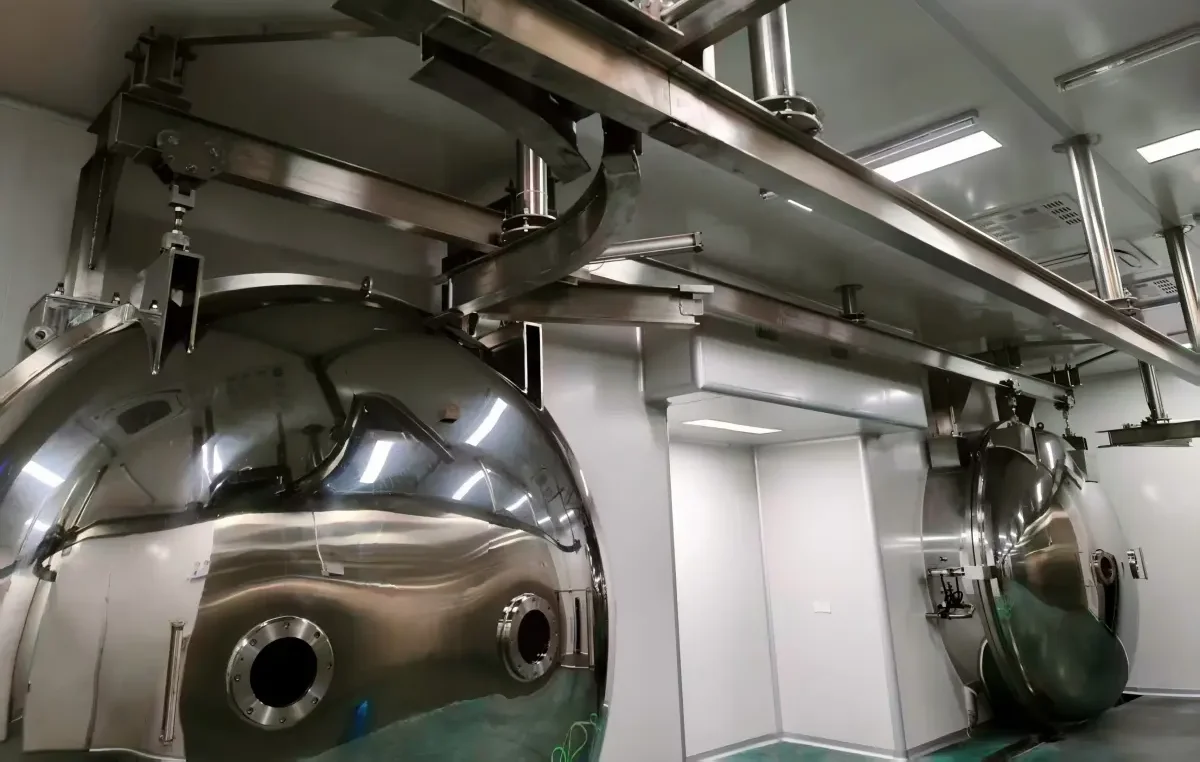
At a facility we established in Ashgabat, Turkmenistan, the client runs three of our 200 m² industrial freeze-dryers. The product list is varied: freeze-dried bananas, peaches, apples and strawberries. Volume is high enough that the 200 m² format is still the right size. Variety alone does not rule out a large dryer; what matters is whether each product can fill a chamber on a regular basis.
When four 50 m² dryers make sense
Short answer: When flexibility matters more than the lowest number of machines to manage.
Several smaller dryers can process different materials at once, and their cycles can be staggered. You switch on only as many units as current orders require, and the others keep producing while one is serviced or reconfigured. This suits plants with a diverse range, large swings in batch size or frequent product switching.
One of our clients makes multi-component products, such as a blend of fruit purée and cashews, built around a specific texture. Components like these tend to dry differently, so each recipe benefits from its own profile and schedule. For that client, a set of 50 m² freeze-drying units fits better than one large chamber.
The cost of that flexibility is more refrigeration, vacuum and control systems. Expect a larger footprint, more operational touchpoints and more daily maintenance.
A hybrid layout is worth pricing
Some plants keep one large dryer for the one or two products that carry most of their volume. They add one or two 50 m² units for new products, trials and short orders. If your demand is uneven, ask for quotes on both the pure and the mixed layout.
Six steps to size your project
- List every product and its forecast annual dried output.
- Convert each to fresh-fruit tonnage with the yield table above (dried kilograms divided by yield).
- Divide by batch size and by a realistic number of batches per dryer per year, allowing for defrost, maintenance and holidays.
- Test the plan against downtime: what happens to deliveries if one dryer stops for a week?
- Check utilities, floor loading, ceiling height and pre-freezing capacity for each layout.
- Request quotes for two layouts on an identical specification and compare installed cost per kilogram of dried output.
What a fruit freeze-dryer needs to get right
Short answer: Fruit is high in water and sugar, so condenser capacity, product temperature control and low-humidity handling decide quality more than chamber size does.
Freeze-drying works by sublimation: ice turns to vapour without melting, which happens only below the triple-point pressure of water, about 611 Pa. The vapour then has to be captured as ice on the condenser. When the condenser falls behind, pressure climbs and the cycle stretches.
Sugar-rich fruit also has a collapse temperature. If product temperature rises above it during primary drying, pieces shrink, turn sticky and lose their structure. The shelf temperature profile has to hold the product below that limit, and a good supplier can show you tested recipes for fruit similar to yours.
Finished fruit is hygroscopic and picks up moisture quickly in humid air. Unload and pack in a dry room, in moisture-barrier packaging. Aim for a water activity well below 0.6, the level under which microbial growth is generally not expected (see the FDA guidance listed below).
| Specification | What to verify | Why it matters for fruit |
|---|---|---|
| Condenser ice capacity | Kilograms of ice per batch, tested | High-moisture fruit loads the condenser heavily |
| Shelf temperature uniformity | Measured data across the full shelf | Uneven shelves give some pieces that collapse and others that stay wet |
| Vacuum control | Working pressure range and control accuracy | Pressure affects drying rate and product temperature |
| Hygienic design | Stainless steel grade, weld finish, cleanability | Sugary residues need thorough cleaning between batches |
| Defrost time | Hours from end of cycle to ready for next load | Affects how many batches you really get per week |
| Data logging | Batch records, alarms, export | Supports traceability and customer audits |
Common mistakes in practice include:
- Loading trays deeper than the rated depth to “gain capacity”, which lengthens the cycle.
- Specifying a large chamber without checking the condenser against the actual fruit moisture.
- Planning no pre-freezing capacity, so the dryer waits for product.
- Leaving packaging as an afterthought, so dried fruit absorbs moisture before it is sealed.
For a closer look at configurations, see our range of industrial fruit freeze-dryers.
How to choose a freeze-dryer supplier at 500 kg to 2000 kg scale
Short answer: Pick the supplier that can show working plants at your size, put performance numbers in the contract and support you after commissioning.
When you shortlist 2000 kg freeze-dryer suppliers, ask for the following in writing:
- References at your scale. A supplier that has built 200 m² plants will handle the utilities, loading and scheduling issues that only appear at that size.
- Guaranteed performance. Cycle time, ice capacity and energy use for your named product, with a defined acceptance test.
- A full utility and site list. Power, cooling, compressed air, floor load and ceiling height, before you sign.
- Compliance documents. For the EU, CE marking under the Machinery Directive 2006/42/EC; note that Regulation (EU) 2023/1230 replaces it from 20 January 2027. Food-contact surfaces should be stainless steel with material certificates, and the equipment must be cleanable enough to support a food plant that follows cGMP rules such as 21 CFR Part 117 in the United States.
- Commissioning and training. Who installs, who starts the first batches, and how many operators are trained.
- Spare parts and remote support. Which parts are stocked, lead times and how faults are diagnosed.
- Clear payment and delivery terms. Including what happens if acceptance tests fail.
Where Matton fits
Our team has more than 13 years of engineering experience in freeze-drying equipment. We supply both layouts discussed here: three-unit 200 m² plants like the one in Ashgabat, and multi-unit 50 m² lines for recipe-driven producers. We recommend a layout from your products and volumes, not from the largest machine we can sell.
Send us your product list, annual volumes, target moisture and site utilities, and our engineers will size the options with you. You can reach them through our engineering team contact page, or read more in our freeze-drying project case studies.
FAQ
How much dried fruit does a 500 kg freeze-dryer make per batch? Roughly 47 to 129 kg, depending on the fruit. Strawberries give about 47 kg, peaches 57 kg, apples 74 kg and bananas 129 kg, based on USDA water-content data, 3% residual moisture and before trimming losses.
How much does an industrial freeze-dryer cost? There is no fixed price, because it depends on shelf area, condenser capacity, vacuum system, materials, automation and utilities. Larger units cost more in total but usually less per square metre of shelf. Compare quotes on identical specifications and include installation, utilities and pre-freezing.
Is a 2000 kg freeze-dryer too large for a small business? Usually, unless you have steady orders that fill it every cycle. A partly loaded batch takes almost the same time and energy as a full one, which raises your cost per kilogram. Starting with a 500 kg unit and adding capacity as orders grow carries less risk.
How long is a freeze-drying cycle for fruit? From loading to unloading, a cycle for sliced fruit often takes around a day. Piece thickness, sugar content and load size all change it, so ask the supplier to guarantee cycle time for your product.
Sources and further reading
- USDA FoodData Central (fdc.nal.usda.gov): water content of raw strawberries, peaches, apples and bananas.
- U.S. Food and Drug Administration, Water Activity (aw) in Foods, Inspection Technical Guide.
- U.S. Code of Federal Regulations, Title 21, Part 117: current good manufacturing practice and preventive controls for human food.
- European Union, Directive 2006/42/EC (Machinery) and Regulation (EU) 2023/1230 (Machinery Regulation).
- NIST and IAPWS reference data: triple point of water, about 611.66 Pa.