I spent months evaluating food retort autoclave source factories before my production line went live, and I want to walk you through exactly what I found — the engineering details, the data, and the questions I wish someone had answered for me sooner. If you’re comparing a rotary retort autoclave company for canned food, retort pouches, or wet pet food production, this guide covers the technical points that actually matter on the plant floor.
Why Does Choosing the Right Rotary Retort Autoclave Company Matter So Much?
When I first started sourcing equipment, I assumed most steam retorts were interchangeable — a pressure vessel, a heat source, a timer. I was wrong. The retort you choose determines your F0 value consistency, your energy bill, your downtime for cleaning, and ultimately whether your canned or pouched products pass third-party audits. A poorly engineered retort creates cold spots inside the basket load, which means either under-processed product (a safety risk) or over-processed product (a quality and cost problem).
That’s why, when comparing a rotary retort autoclave company against a static retort supplier, I focused on three things: heat distribution uniformity, water/steam efficiency, and how easily the internal components could be cleaned and validated. Matton’s engineering documentation stood out because it didn’t just claim “even heating” — it explained the mechanical reasoning behind it, down to the spray hole cross-sections and pump flow calculations. For a plant manager who has to defend process deviations to auditors, that level of documented detail is worth more than a glossy brochure.
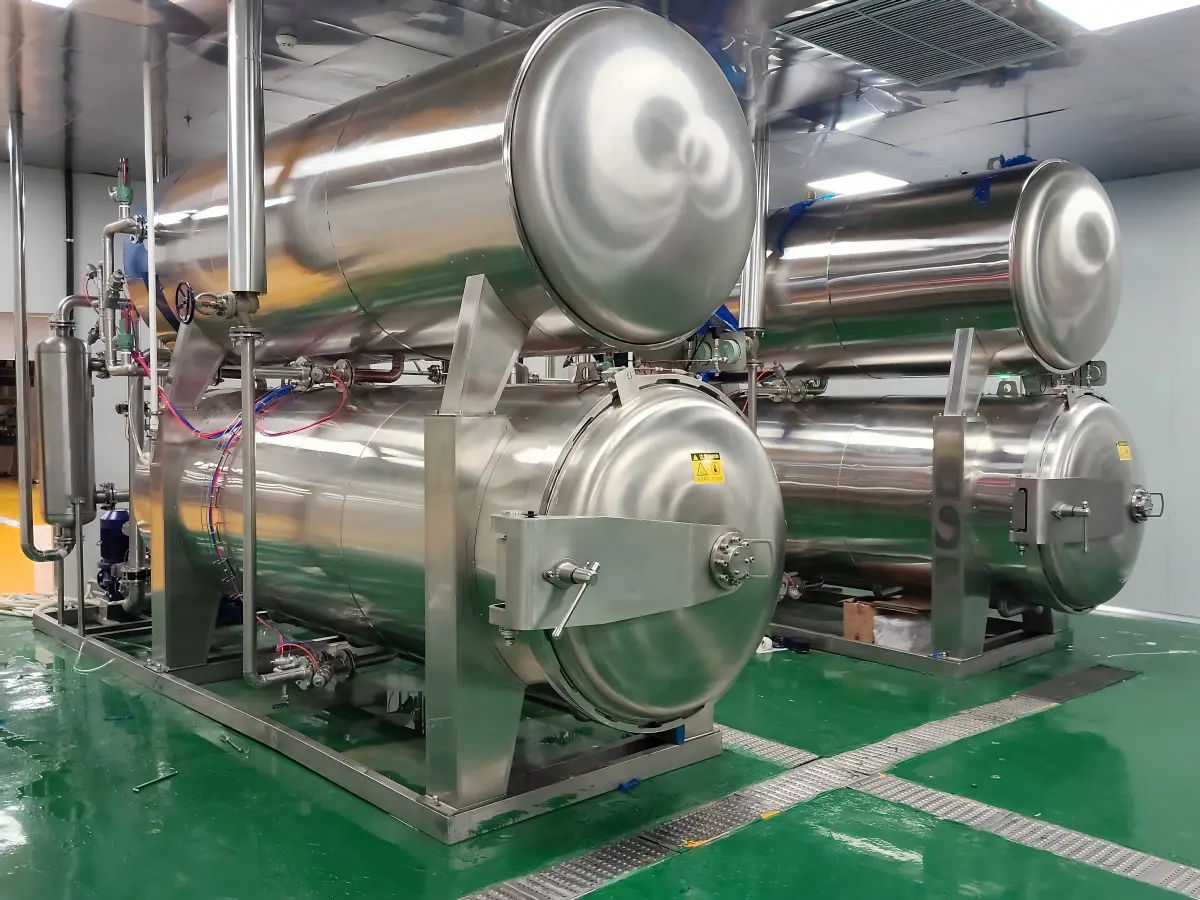
I also learned that MATTON creates a file for every machine to provide lifelong technical and spare parts support—this has completely transformed my experience regarding spare parts, technical assistance, and custom container sizes for existing cooking chambers.
How Does a Steam Retort Autoclave Factory Ensure Uniform Sterilization?
This was my biggest technical question going in: how do you guarantee that every basket, top to bottom and edge to center, receives the same thermal treatment during a spray-water cycle?
What Role Does the Spray Water System Play?
Matton’s retorts use a water-spray sterilization method combined with indirect heating and cooling rather than direct steam-only exposure. The spray piping is welded from stainless steel round tubing, and the internal spray layout is split using a one-to-two, then two-to-four branching configuration. This isn’t arbitrary — the cross-sectional area of each branch pipe’s spray holes, and the holes in the spray baffle plates, are calculated against the water pump’s flow rate so that a consistent 3–4 cm layer of water sits above the spray baffle at all times. That standing water layer is what creates the turbulence needed to eliminate stratified hot and cold zones inside the vessel. As a practical bonus, the straight spray pipes use quick-disconnect fittings, so operators can pull them for manual cleaning without needing a maintenance crew to disassemble the whole spray header.
Why Does Spray Baffle Design Matter for Basket-to-Basket Consistency?
The spray baffle plates themselves are formed from 3mm cold-rolled stainless steel and bent rather than welded from thinner sheet, which resists warping under repeated thermal cycling. Each baffle has a top-mounted support bracket so it can be lifted out for CIP (clean-in-place) servicing between production runs. A horizontal, high-flow, low-head water pump keeps circulation fast enough that a 40mm layer of high-temperature water is maintained continuously above the baffle — this is the detail that answers the question every retort operator asks: “does the basket on the bottom rack get the same treatment as the one on top?” With this design, the answer is yes, because every basket sits under the same water depth and flow regime.
What Spray System Technology Sets Matton Apart From Generic Retort Suppliers?
I want to spend more time here because this is where I saw the clearest gap between a generic steam retort autoclave factory and one that has actually invested in thermal engineering.
Most budget retort manufacturers use a single spray manifold with uniform hole sizing across the entire header. The problem is that water pressure naturally drops as it travels further from the pump inlet, so baskets near the far end of the spray header receive less water volume than baskets near the inlet. Matton’s approach — precisely varying branch pipe and baffle hole cross-sections based on pump flow calculations — compensates for that pressure drop before it ever becomes a temperature inconsistency inside the vessel.
From a food safety standpoint, this matters because your process authority’s scheduled process is only valid if the come-up time and holding temperature are genuinely uniform across the entire load. If your retort has hidden cold spots, you may be complying with your written process on paper while still under-processing a portion of every batch. I’ve seen smaller operations get flagged during third-party audits specifically because their retort’s heat distribution study showed more than a 1°C spread across the basket load — something a well-designed spray system is engineered to avoid from the start.
How Does the Heat Exchanger Design Save Energy and Improve Reliability?
Energy cost was the line item that finally justified the equipment upgrade to my finance team, so I dug into how Matton’s heat exchanger actually works.
The retort uses a stainless steel spiral-wound heat exchanger for indirect heating and cooling of the circulating water, rather than injecting live steam directly. This spiral design was co-developed with a Polish engineering partner specifically for sterilization applications, and the exchange tubes are thin-wall seamless stainless steel that has been specially formed into the coil pattern. Because the transfer elements have a larger bore and a streamlined wave-shaped profile, pressure loss through the exchanger is reduced compared to conventional shell-and-tube designs, which in turn lowers pumping energy requirements.
The indirect design also allows the system to recover low-temperature heat that would otherwise be wasted, which is where the efficiency gain compounds. In practical terms, this heat recovery and reduced pressure loss combination is documented to save an average of roughly 10% on steam consumption compared to a conventional direct-steam retort of similar capacity. Over a multi-year equipment lifecycle, running a retort room with a dozen or more vessels, that steam savings adds up to a meaningful reduction in utility spend — often enough to materially shorten the payback period on the capital investment.
At the same time, because this heat exchanger exerts less thermal shock on the piping, there is also less fouling. This means longer intervals between descaling or inspections.
How do you evaluate and select “food retort autoclave source factories”?
This search term gave me a clearer understanding of buyer intent: processors want to bypass the markups and communication delays associated with middlemen. I made the same choice, and here is how things changed after I started sourcing directly from the factory:
First, communication regarding customization became faster and more professional. I can now directly discuss rack configurations, spray nozzle layouts, and control system integration. Second, response times for spare parts and after-sales support improved, as the factory manufacturing the welded spray manifolds and coiled heat exchangers also stocks the necessary replacement components. Third, quality documentation—such as material certificates, pressure vessel test reports, and piping standard compliance records—comes directly from the manufacturer’s quality department.
If you are evaluating suppliers for food retorts, I recommend asking specific questions: What is their market share in their home country, and do they have an in-house after-sales team? Advertisements on B2B platforms do not necessarily indicate a factory; in fact, genuine factories often prefer traditional methods for international trade. The answers to these questions will reveal whether you are dealing with a legitimate rotary retort manufacturer or a distributor merely branding themselves as a factory.
What Quality Standards and Certifications Should a Retort Vessel Meet?
Before signing any purchase order, I insisted on documentation covering three areas: pressure vessel inspection, piping standards, and thermal uniformity data.
Matton’s retort bodies are inspected and certified by the relevant quality and technical supervision authority as a pressure vessel, which is the baseline requirement for any sterilization equipment operating under pressure. Beyond that, the internal piping layout is designed and manufactured according to U.S. FDA standards, which matters if your finished product is destined for U.S. retail or export markets subject to FDA low-acid canned food (LACF) regulatory review. Combined, these two certifications give a plant manager a defensible paper trail: the vessel itself is safety-certified, and the process-contact piping meets the regulatory framework your process authority will reference when reviewing your scheduled process.
I’d encourage anyone comparing suppliers to request the actual certificates rather than accepting a general claim of “FDA compliant” — ask for the specific standard numbers referenced in the piping design documentation, and confirm the pressure vessel certificate corresponds to the exact model you’re purchasing, not a general product line.
How Does Rotation Improve Sterilization for Different Product Types?
One question I hadn’t considered carefully before starting my search was how rotation speed and direction interact with product viscosity. Canned soups, sauces, and wet pet food behave very differently under agitation than solid-pack products like whole vegetables or tuna.
Does Rotation Speed Need to Be Adjustable?
For liquid or semi-liquid products, faster rotation increases convective heat transfer inside the can or pouch, which can meaningfully shorten the required holding time and reduce over-cooking at the can wall. For particulate or solid-pack products, however, aggressive rotation can damage product structure or cause settling issues. Because of this, I looked specifically for retorts offering adjustable rotation speed and reversible rotation direction, rather than a single fixed setting. Matton’s rotary retort autoclave line supports variable-speed rotation control integrated with the same PLC that manages the spray water and heat exchanger cycle, which meant my process authority could tailor the rotation profile separately for each product SKU running through the same vessel.
How Does This Affect Retort Pouch and Can Format Compatibility?
I also had to confirm that a single rotary retort could handle mixed formats — metal cans, retort pouches, and semi-rigid trays — without needing separate dedicated vessels for each. The basket and rack design determines this more than the retort body itself, so I made sure to specify my exact container dimensions and case configurations during the quoting process.
What Does Total Cost of Ownership Look Like Over the Retort’s Lifespan?
Sticker price is only one part of the equation, and it’s often the least useful number for comparing a rotary retort autoclave company against a competitor. When I built out my own cost model, I broke total cost of ownership into four buckets: capital cost, utility consumption, maintenance and spare parts, and downtime risk.
Utility consumption was where the indirect spiral-wound heat exchanger made the clearest difference, given the roughly 10% steam savings documented for this design compared to direct-steam alternatives. On a retort running multiple cycles per day, that savings compounds quickly across a full production year. Maintenance costs were harder to quantify up front, but the removable spray baffles and quick-disconnect spray pipes meant my maintenance team could complete routine descaling and CIP cycles without scheduling a full-day teardown, which reduced both labor hours and unplanned downtime risk. Spare parts availability, discussed earlier, also feeds directly into downtime risk — a factory that stocks its own baffles, pump seals, and heat exchanger components can typically ship replacements faster than a distributor waiting on a manufacturer overseas.
When I finally compared total five-year cost projections across three suppliers, the vessel with the higher upfront price but lower steam consumption and lower projected maintenance downtime came out ahead by a meaningful margin — a detail that wouldn’t have shown up if I’d compared quotes on sticker price alone.
Comparing Retort Sterilization Approaches: A Data Snapshot
The table below summarizes the differences I evaluated between a conventional direct-steam retort and Matton’s indirect spray-water design, based on the engineering documentation I reviewed and typical industry benchmarks for comparable vessel sizes.
| Feature | Conventional Direct-Steam Retort | Matton Spray-Water Retort (Indirect) |
|---|---|---|
| Heating/cooling method | Direct steam injection | Indirect via spiral-wound heat exchanger |
| Spray manifold design | Uniform hole sizing | Calculated 1-to-2 / 2-to-4 branching, variable hole cross-section |
| Water layer above baffle | Not controlled | Maintained at 3–4 cm |
| Baffle-top hot water layer | Varies by design | Maintained at ~40 mm |
| Baffle material/thickness | Often 1.5–2mm formed sheet | 3mm cold-rolled stainless steel, bent |
| Cleanability | Fixed spray pipes, harder to service | Quick-disconnect spray pipes, removable baffles for CIP |
| Reported steam savings | Baseline | ~10% average reduction |
| Pipe standard reference | Varies by supplier | Designed to U.S. FDA piping standards |
| Vessel certification | Varies by supplier | Inspected and certified by quality/technical supervision authority |
What Should You Ask a Rotary Retort Autoclave Company Before Ordering?
Based on my own sourcing process, here’s the short checklist I used with every supplier I contacted:
– What is my product? What packaging method should I choose, and what are the dimensions?
– What is the documented steam or energy consumption per cycle compared to a direct-steam alternative?
– Are the spray pipes and baffles removable for manual or CIP cleaning without a full teardown?
– Which pressure vessel and piping standards does the vessel comply with, and can you provide the certificates?
– What is your typical lead time for spare parts like spray baffles, pump seals, or heat exchanger components?
I’d also suggest asking about control system architecture and data logging capability. Modern retort validation increasingly relies on digital process records rather than paper chart recorders, and regulators and third-party auditors are generally more comfortable with systems that timestamp and archive temperature, pressure, and rotation data automatically. A rotary retort autoclave company that offers PLC-based control with exportable batch records will save your QA team significant time during audits and recalls, compared to manually transcribing chart recorder data after every cycle.
My Honest Take After Working With a Steam Retort Autoclave Factory
I won’t pretend the sourcing process was frictionless — international equipment procurement rarely is, between shipping logistics, installation coordination, and getting my QA team comfortable with a new process authority validation. But the technical transparency made the difference. When I asked why the spray baffle was 3mm instead of a thinner, cheaper gauge, I got an engineering explanation about thermal cycling resistance, not a shrug. When I asked about the ~10% steam savings figure, I got a description of how the spiral-wound exchanger’s larger-bore, streamlined tubing reduces pressure loss and recovers low-grade heat — not just a marketing number.
If you’re currently comparing rotary retort autoclave company options, my advice is simple: push past the sales brochure and ask for the mechanical reasoning behind every claim. A factory that built its own spray hole calculations and heat exchanger design will have that reasonin.
Frequently Asked Questions
1.What is the difference between standard retorts using plate heat exchangers and MATTON retorts?
Plate heat exchangers (basic configuration): Fouling accumulates in narrow inter-plate channels, leading to reduced heat transfer efficiency and increased pressure drop over time, necessitating complete disassembly for individual plate cleaning; gaskets are wear-prone components, posing risks of failure and cross-contamination due to repeated thermal cycling.
MATTON spiral-wound heat exchangers: Feature a single continuous coil with large, streamlined channels that resist fouling, while continuous fluid directional changes create a self-cleaning effect; the absence of internal gaskets structurally eliminates this failure mode—a technical foundation that supports the reported ~10% steam savings.
2. How much steam or energy can an indirect spray-water retort actually save?
Based on the heat exchanger design documented for Matton’s retorts, indirect heating through a spiral-wound stainless steel exchanger with reduced pressure loss and heat recovery capability is reported to save an average of approximately 10% on steam consumption compared to conventional direct-steam systems.
3. Why does spray water depth above the baffle matter for sterilization quality?
Maintaining a controlled water layer (3–4 cm above the baffle, with a 40mm hot water layer at the baffle top) ensures consistent turbulence and water volume reach every basket in the load, which prevents localized cold spots that could otherwise cause under-processing in parts of the batch.
4. What certifications should I verify before buying from a retort autoclave factory?
At a minimum, it should be verified that the pressure vessel has passed inspection and certification by the relevant quality and technical supervision authorities, and documentation should be requested to prove that the internal piping design complies with recognized standards (such as CE or ASME certification).
5. Why does MATTON operate under multiple company names?
Zhucheng Maiteng Machinery Technology Co., Ltd. and Zhucheng Maidun Import & Export Co., Ltd. are both part of the MATTON Group. The Group not only exports machinery but also supplies food products to food processing plants worldwide, bringing global culinary delights to China.
—
Thanks to our partners from the International Potato Tour (IPT) for their excellent presentation.
—
Are you ready to compare your existing sterilization equipment with the specifications of the new system? Please contact the Matton engineering team to obtain heat distribution data sheets and a customized quote tailored to your production line.