

Doubel Water-bath Retort
Products


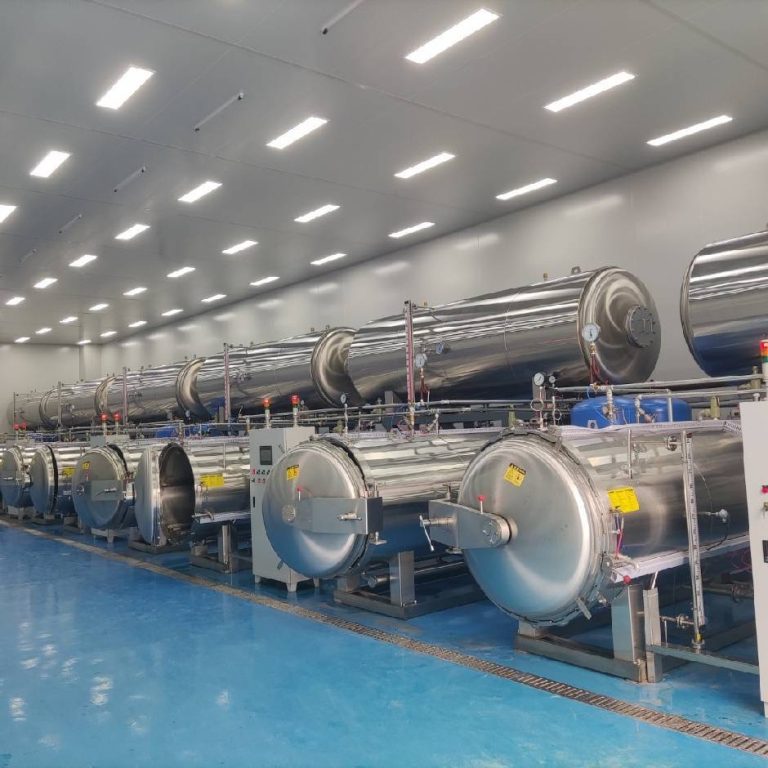
Matton’s double water-bath retorts are purpose-built for gentle, uniform thermal processing of cans, jars and pouches where product integrity and delicate texture retention are priorities. Unlike spray or steam retorts, the double water-bath method immerses product containers in a controlled, circulating water mass—often in two sequential baths—to achieve very even heat transfer with minimal mechanical stress. This approach is particularly well suited to sensitive foods such as whole fruits, delicate seafood, premium ready meals and products where appearance and mouthfeel are critical to market acceptance.
Principle of Operation
A double water-bath retort uses two contiguous water tanks (or chambers) through which product baskets or trolleys pass. The first bath provides progressive heat-up and sterilization while the second bath can be used for final temperature equalization, tempering, or staged cooling depending on the process design. Typical heating is supplied indirectly (steam or hot water jacket) to the baths; internal circulation pumps and carefully engineered flow channels eliminate cold zones and ensure consistent thermal exposure across all load positions.
Core process stages:
-
Load & Immerse: product racks/baskets enter the first bath and are fully submerged.
-
Heat-up & Sterilize: controlled heating profile raises the core temperature to the target F-value; dwell times are maintained to meet microbiological criteria.
-
Transfer to Second Bath: product moves into the second bath for additional thermal equalization, reduced overcooking, or controlled cooling.
-
De-pressurize & Unload: after cycle completion, racks are removed; optional cooling or air-blow stations follow to prepare product for downstream handling.
Advantages for Procurement & Process Engineers
-
Extremely even heat transfer: immersion eliminates hot/cold spots typical of convective systems, producing highly repeatable sterilization across load positions.
-
Low mechanical impact: absence of high-velocity sprays or direct steam minimizes agitation and physical stress—ideal for fragile or shaped products.
-
Simplified load handling: robust baskets and trolleys allow easy loading/unloading with predictable thermal exposure.
-
Process flexibility: second bath can be configured for tempering, staged cooling, or specialized finishing (e.g., salt brine tempering) to meet product-specific goals.
-
Lower risk of package damage: gradual pressurization and hydrostatic support reduce deformation risks for thin-walled cans and flexible pouches.
Engineering & Design Highlights
-
Dual-bath hydraulics: engineered flow paths and multi-point inlets ensure laminar mixing and homogenous temperature distribution without excessive turbulence that could damage products.
-
Indirect heating jackets: steam or thermal fluid heat the bath water via jackets or external heat exchangers to avoid direct steam contact with product surfaces.
-
Precision temperature control: PID controllers and multi-zone temperature sensing maintain bath setpoints with narrow tolerances to protect heat-sensitive attributes.
-
Sanitary construction: food-grade stainless steel (316L/304) for product contact, hygienic welds, sloped drains and CIP provisions for each bath.
-
Safety & pressure management: interlocks, emergency stop, overpressure protections and accessible venting systems for safe operation.
Typical Applications
-
Whole or halved fruit in syrup (peaches, pears) where visual quality matters.
-
Delicate fish fillets or shellfish requiring controlled texture retention.
-
High-value ready meals and premium products with layered textures.
-
Low-acid products where careful control of F-value is required to avoid overprocessing.
Control, Data & Traceability
Matton equips double water-bath retorts with modern control systems to satisfy QA and procurement documentation needs:
-
Recipe management (F-value targets, ramp profiles, bath setpoints).
-
Comprehensive logging of temperature, water level, pump status and cycle events for each load.
-
Batch identification and operator sign-on for traceability.
-
Exportable validation reports (CSV/PDF) for integration into client QA systems or third-party audits.
Representative Technical Specifications (example ranges)
| Parameter | Typical Range / Option |
|---|---|
| Bath volume | 0.5 m³ (pilot) to 50 m³ (industrial) per chamber |
| Working temp | Ambient up to 130°C (process dependent) |
| Heating source | Steam jacket / thermal oil / indirect electric |
| Circulation rate | 0.5 – 30 m³/hr (per pump) depending on bath size |
| Pressure control | Atmospheric to ~2 bar gauge for pressure-assisted cycles |
| Construction | 304/316L SS product contact; drainable floor design |
| Loading | Basket/trolley systems with automated indexing optional |
| Control | Siemens/Allen-Bradley PLC, touchscreen HMI, data logging |
Factory Acceptance Testing (FAT) & Validation
Matton provides FAT packages specifically designed for immersion processes:
-
Thermal mapping with calibrated thermocouples placed at strategic container positions to demonstrate uniform heating and required F-values.
-
Hydraulic verification to confirm circulation pattern, flow rates and absence of dead zones.
-
Leak & drain testing for bath integrity and CIP effectiveness.
-
Control validation including recipe execution, alarm handling and data export.
-
Witness & documentation: FAT reports, photo/video evidence and third-party inspection options are available upon request.
Installation, Commissioning & Site Requirements
Matton supports full project delivery including:
-
Pre-installation survey: verify utilities (steam, electricity, water supply & return), floor loading and drainage.
-
Mechanical & hydraulic hookup: alignment of trolley systems, piping, pumps and heat sources.
-
Control system commissioning: recipe upload, sensor calibration and network integration.
-
SAT & operator training: site acceptance tests using representative loads and training for operational and maintenance staff.
Maintenance, Spare Parts & Service
To ensure long service life and minimal downtime, Matton recommends:
-
Routine checks: pump seal integrity, bearing lubrication, nozzle cleanliness and thermocouple calibration.
-
Spare parts kits: pump seals, gaskets, level sensors, temperature probes and control modules tailored to the installed configuration.
-
Scheduled CIP & inspection: planned cleanings and inspection intervals to avoid biofilm or scale buildup in baths.
-
Field support options: remote diagnostics, on-site service engineers and tailored service contracts with defined SLAs.
Customization & Integration
Matton can adapt double water-bath retorts to project-specific needs:
-
Variable bath staging (e.g., heat-up → sterilize → temper) for bespoke process curves.
-
Load fixtures designed for unusual container geometries or multi-SKU operations.
-
Automated transfer systems between baths to minimize manual handling and cycle time.
-
Integration with upstream fillers and downstream cooling/packing lines for seamless production flow.
-
Special materials/coatings for aggressive chemistries or extended wear resistance.
Regulatory & Quality Documentation
We provide the documentary support required by procurement and regulatory teams:
-
Material and mill certificates for wetted parts.
-
Weld logs and NDT reports where applicable.
-
FAT reports, thermal mapping data and validation protocols.
-
Machine safety dossiers and CE-related documentation (when required).
-
HACCP/GMP design documentation and CIP validation notes.
Downloadable Resources & Support
Qualified buyers can request detailed datasheets, sample FAT templates, thermal mapping examples and an installation checklist. Matton also arranges factory visits and witnessed FAT sessions in Zhucheng for procurement inspections.
Frequently Asked Questions (FAQs)
Q1: For which products is a double water-bath retort preferable to spray or continuous systems?
A1: Double water-bath retorts excel with fragile, high-value or shape-sensitive products (whole fruit, delicate seafood, premium meals) where immersion provides the gentlest and most uniform heat transfer without mechanical agitation.
Q2: Can the second bath be used for controlled cooling?
A2: Yes. The second bath can be configured for tempering, staged cooling or to introduce a different medium (e.g., chilled water or brine) to tailor product finishing while maintaining gentle handling.
Q3: How do you verify uniformity across a large trolley load?
A3: We place calibrated thermocouples in representative containers across the trolley during FAT and pilot runs, generate thermal maps and report peak, average and cold-spot temperatures along with calculated F-values for validation.
Q4: What are the primary maintenance concerns for water-bath systems?
A4: Key areas include maintaining pump seals, preventing scale or biofilm in bath water (CIP and water treatment), checking level controls and replacing worn gaskets or thermocouples on a scheduled basis.
Q5: Is a double water-bath retort energy-efficient?
A5: While immersion systems can require significant heating of a large water mass, Matton implements efficient heat recovery options, insulated bath designs and precise control strategies to minimize steam/energy use while preserving product quality.