

Retort
Products


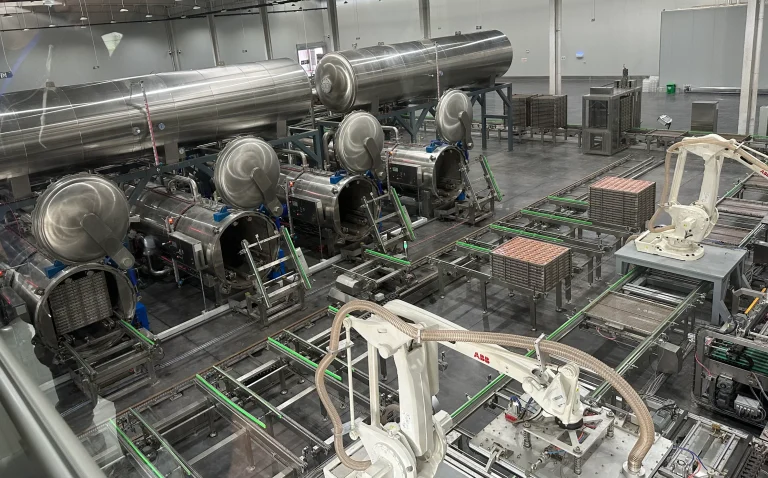
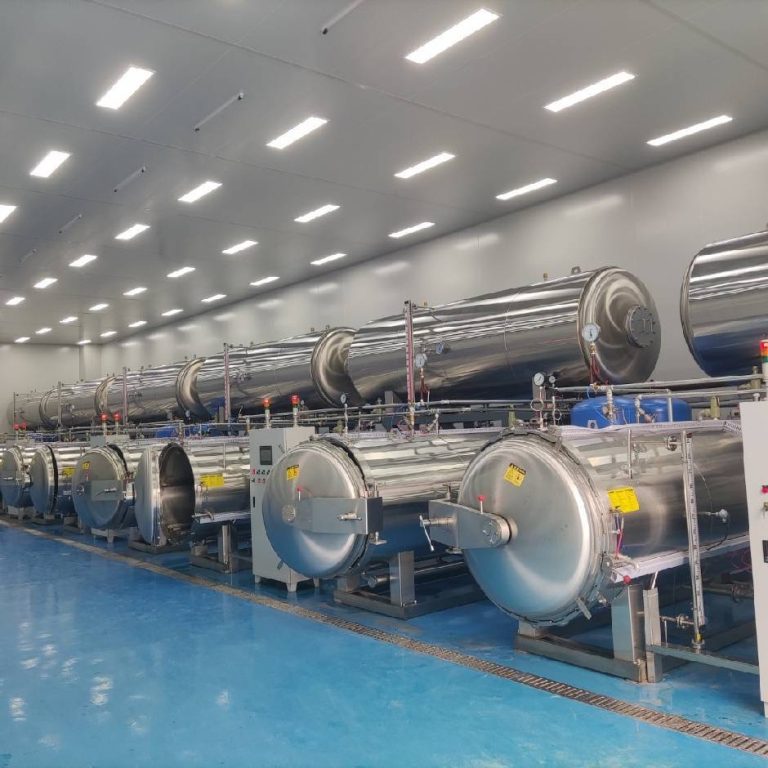
Matton’s retort solutions are engineered to provide validated thermal processing for a wide range of packaged foods — from low-acid ready meals and pouches to canned vegetables and pet foods. Retort sterilization uses controlled heat and time (often expressed as an F-value) to inactivate target microorganisms while preserving product quality. Our focus is delivering engineering-grade retort systems that balance process control, operator safety, hygienic design and predictable total cost of ownership for procurement teams and process engineers.
Why choose the right retort?
Selecting the correct retort topology and control strategy is a critical procurement decision. The retort type determines cycle time, utility demand, product appearance and throughput. Mist-sizing a system or choosing the wrong heat-transfer mechanism commonly leads to overprocessing, high energy bills or rework. Matton advises clients through a structured selection process so the chosen system meets microbiological, quality and commercial targets.
Retort Selection Matrix (high-level)
| Selection Factor | Batch Retort | Water Spray | Double Water-Bath | Continuous Retort |
|---|---|---|---|---|
| Best for | Small batches / flexible SKUs | Moderate throughput, robust cans/pouches | Fragile/high-value products | Very high throughput, low labor |
| Heat transfer speed | Moderate | Fast | Very uniform, gentlest | Tunable (high) |
| Typical utility demand | Medium | High (short cycles) | Moderate–High | Optimized (heat recovery) |
| Process repeatability | Good | Very good | Excellent | Excellent, with high consistency |
| Ease of validation (F-value mapping) | Straightforward | Straightforward | Straightforward | Demands rigorous mapping |
| Capital cost | Low–Medium | Medium | Medium–High | High |
Key engineering considerations
-
Thermal profile control: Accurate temperature ramp, dwell and cooling stages are essential. Matton’s PLC-driven recipe management ensures repeatable F-value achievement and supports batch traceability.
-
Package handling & orientation: Container geometry and fill temperature affect thermal penetration. We design basket/trolley fixtures and infeed mechanisms to minimize variation between positions.
-
Materials & sanitary design: All product-contact surfaces use food-grade stainless steel (304/316L) with hygienic welds, accessible joints and drainable geometry to meet HACCP and GMP expectations. CIP-friendly features are available for applicable processes.
-
Pressure & safety engineering: Where pressurized cycles are required, retorts are designed to relevant pressure-vessel codes and include interlocks, pressure relief, and safety layer PLCs.
-
Control & data integrity: Our retorts log temperature/pressure/time data in tamper-evident formats and support export to MES/ERP for QA audits and recall traceability.
Process Validation & QA support
Matton provides a complete validation package to support regulatory reviews and buyer audits:
-
FAT protocol and witness testing options.
-
Thermal mapping with calibrated thermocouples and statistical reporting of cold-spot behavior.
-
Repeatability trials and acceptance criteria (come-up time, Tmax, minimum cold-spot F-value).
-
Full traceability documentation: material certificates, weld logs, calibration certificates and electrical schematics.
Integration, Automation & Data
Retorts rarely sit alone — they are part of a production sequence. Matton integrates retorts with upstream filling, conveyor interfaces and downstream cooling/packing systems. Automation highlights:
-
Recipe libraries and operator-level access control.
-
Alarm prioritization, event logging and OEE metrics.
-
Secure remote diagnostics and software update channels for fast troubleshooting.
-
Barcode/RFID traceability to connect retort cycles with batch IDs and raw material lots.
Energy Efficiency & Sustainability
Thermal processing consumes significant utilities. Matton engineers optimize lifecycle energy through:
-
Heat recovery modules that reclaim condensate energy to preheat make-up water or boiler feed.
-
Insulation & door sealing to minimize radiation and infiltration losses.
-
Optimized pressurization strategies that reduce steam use while protecting package integrity.
-
Choice of heat source (steam, thermal oil, electric) matched to local utility economics and sustainability targets.
Lifecycle Cost & Procurement Checklist
| Cost Category | What procurement should evaluate |
|---|---|
| Capital expenditure | Equipment price, footprint, civil works, integration cost |
| Utilities & OPEX | Steam/electricity consumption per cycle, condensate handling |
| Maintenance | Spare parts commonality, ease of access, MTTR targets |
| Validation & compliance | FAT scope, witness costs, documentation package |
| Scalability | Modular additions, multi-line sync, PLC I/O headroom |
Matton provides comparative lifecycle models for key projects so procurement can evaluate Net Present Cost (NPC) across competing technical options.
Serviceability & After-sales
To minimize production risk, Matton builds serviceability into equipment and supports it operationally:
-
Recommended spare parts lists tailored to duty cycle.
-
Preventive maintenance schedules focused on pumps, seals, sensors and safety devices.
-
Remote monitoring packages that alert on trending issues (e.g., slow come-up time indicating degraded heat transfer).
-
On-site commissioning, operator training and optional extended service agreements with SLA commitments.
Customization & Retrofitting
Matton routinely customizes retorts to match unique product needs or retrofits existing lines to improve performance:
-
Retrofit examples include adding heat recovery, upgrading controls for improved recipe management, replacing manual loading with semi-automated infeed, and converting spray systems to gentler immersion setups for delicate products.
-
We also supply custom load fixtures and specialized coatings for aggressive chemistries.
Comparative Advantages of Matton Retorts
-
Engineering-first approach that emphasizes validated performance and QA documentation.
-
Modular designs that reduce lead time for phased capacity expansions.
-
On-site FAT with structured witness options and transparent reporting.
-
In-house manufacturing in Zhucheng for better control over lead times and spare-part continuity.
Short Case Example (anonymized)
A branded food manufacturer needed to scale a delicate seafood product from 2-t/day pilot to full production without texture degradation. Matton engineered a double-bath retort solution with tailored basket geometry and staged tempering in the second bath. Result: product yield increased 6%, customer retained premium market positioning, and steam consumption fell 12% after heat-recovery retrofit.
FAQs
Q1: How is an F-value determined and why does it matter?
A1: The F-value quantifies microbial lethality based on temperature and time. It’s determined through thermal mapping and microbiological validation and is the primary acceptance metric for sterilization. Matton’s validation package calculates and documents F-values across load positions.
Q2: Which retort type minimizes cosmetic damage to thin-walled cans and pouches?
A2: Immersion-based systems (double water-bath) and carefully controlled spray systems with moderated pressure ramps typically reduce container deformation compared with aggressive steam-only cycles.
Q3: What are typical utilities required for a retort installation?
A3: Common utilities include saturated steam (specified pressure/flow), electrical power for drives and controls, process water and drainage, compressed air for actuators, and condensate return or disposal arrangements.
Q4: Can Matton assist with third-party witness tests and buyer audits?
A4: Yes. Matton coordinates FAT schedules, accommodates third-party inspectors and supplies structured documentation to satisfy buyer validation requirements.
Q5: How do I evaluate whether to buy a batch or continuous retort?
A5: Evaluate target throughput, SKU mix, labor constraints, and validation practices. Batch systems are flexible and lower capex for low volumes; continuous retorts are justified for high, stable throughput when minimizing labor and achieving consistent product quality is a priority. Matton provides comparative analyses during the quotation phase.