

Freeze dryer
Products


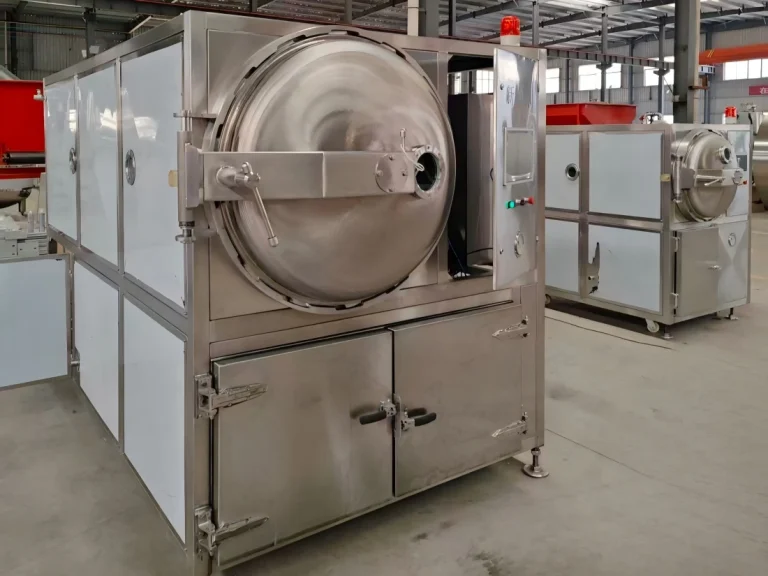
Matton designs and manufactures industrial-grade freeze dryers (also called lyophilizers) for application across food, pharmaceutical, nutraceutical, and R&D sectors. From compact pilot units for cycle development to high-capacity continuous systems, our freeze dryers are engineered for repeatable vacuum control, precise shelf temperature management, efficient condenser capacity and documented performance validated through Factory Acceptance Testing (FAT). Matton’s in-house refrigeration expertise (ammonia or CO₂ systems), modular mechanical design and process R&D services mean procurement teams and process engineers receive a turnkey lyophilization solution that meets GMP, HACCP and buyer validation requirements.
Types & configurations
Matton freeze dryers are offered in modular configurations to match product requirements, throughput and facility constraints:
-
Pilot / Laboratory Lyophilizers — small footprint, precise shelf temperature control, ideal for cycle development, R&D and small-batch production. Often used with thermal mapping, Karl Fischer moisture testing and pilot-scale sample racks.
-
Commercial / Batch Freeze Dryers — medium-capacity batch chambers with multiple shelves, designed for production-scale runs. Suitable for food ingredients, probiotics, botanical extracts and small pharmaceutical batches.
-
Industrial / High-Capacity Freeze Dryers — large multi-shelf or multi-chamber systems, including cascade or continuous freeze-drying solutions for high-throughput food and bulk pharmaceutical APIs.
-
Continuous Lyophilizers — for very high throughput or continuous processing models; engineered for even heat distribution and integrated with upstream freezing and downstream packaging.
Each configuration is configurable for shelf area, condenser capacity, vacuum system sizing and control features to match the thermal mass and moisture load of the specific product.
Core components & engineering features
A reliable freeze dryer is more than a vacuum chamber — it’s an engineered system of thermal, mass-transfer and control subsystems:
-
Vacuum chamber and shelves: precision-machined shelves with uniform heat transfer, typical shelf temperature ranges from -50°C to +70°C depending on heating method (shelf heating via thermal fluid, electric, or steam). Shelves incorporate rapid and uniform temperature control to manage sublimation rates.
-
Condenser unit (cold trap): designed condenser capacity to capture sublimated vapour; condenser sizing is a critical parameter (kg H₂O/day or kW) that must match the product’s sublimation rate and expected cycle runtime.
-
Vacuum pumps & roughing pumps: typically multi-stage rotary vane, dry pumps or roots/backing combinations sized for final vacuum level and moisture throughput. Consider oil-free vacuum options for pharmaceutical/GMP needs.
-
Refrigeration system: low-temperature refrigeration plant to maintain condenser setpoints; Matton offers ammonia (NH₃) and CO₂ (R-744) refrigeration systems with options for cascade designs for very low condenser temperatures.
-
Heating system: shelf heating via electrical cartridge heaters, thermal fluid circuits or steam jacketing to manage primary and secondary drying phases. Good control bandwidth (rapid ramping) reduces cycle time.
-
Control & automation: PLC-based recipe control, PID loops for shelf temp and condenser control, vacuum control, alarm management, data logging and optional MES integration. Batch traceability and tamper-evident logs are available for regulated industries.
-
Load-handling & racks: sliding trays, trolleys, or automated infeed/outfeed for higher-throughput systems; materials and fixture design optimized for uniform loading and minimal cold spots.
-
Instrumentations: calibrated thermocouples, pressure transducers, vacuum gauges (Pirani, cold cathode), and product temperature probes for thermal mapping and validation.
LSI note: engineers should reference sublimation rate, heat transfer coefficient (U-value), vacuum level (mbar or Pa) and residual moisture (% w/w) when sizing systems.
Refrigeration choices: ammonia vs CO₂ (and cascade options)
Refrigeration strategy affects CAPEX, operating cost, environmental footprint and regulatory complexity:
-
Ammonia (NH₃): excellent thermodynamic efficiency for large condenser loads; lower energy per kW refrigeration for industrial capacities. Requires trained technicians, adherence to local ammonia codes, and specific safety measures (venting, leak detection). Preferred for large industrial freeze dryers where energy efficiency and total cost of ownership matter.
-
CO₂ (R-744): low Global Warming Potential (GWP) refrigerant, easier regulatory acceptance in some jurisdictions; performance at very low condenser temperatures can require cascade or transcritical system design. CO₂ systems are growing in adoption where environmental policy or refrigerant restrictions favor low-GWP options.
-
Cascade systems: combine refrigerants (e.g., NH₃ primary, CO₂ secondary) to reach very low temperatures efficiently. Useful for specialty pharmaceutical lyophilization requiring condenser setpoints below -80°C.
Decision factors: required condenser temperature, local refrigerant regulations, facility skills, TCO modeling (energy + maintenance), and safety infrastructure.
Process science: primary drying, secondary drying & residual moisture
Understanding lyophilization stages is essential for cycle design and freeze dryer sizing.
-
Freezing (preconditioning): controlled freezing strategy (slow vs rapid) affects ice crystal size; larger crystals generally enable faster sublimation but can influence porous structure and final product quality. Engineers should document nucleation and freezing profiles.
-
Primary drying (sublimation): under vacuum, ice sublimates from product; shelf temperature and chamber pressure are controlled to maintain product temperature below collapse or eutectic points. Primary drying duration depends on heat flux to the product and vapour transport capacity (condenser and vacuum system).
-
Secondary drying (desorption) — raises shelf temperature (typically under vacuum) to remove bound water and reach target residual moisture (typically expressed as % w/w or water activity, aw). Residual moisture targets vary by product: pharmaceuticals often require <1.5% w/w; food applications vary widely (e.g., 1–6% depending on intended shelf life and rehydration).
Key analytics: Karl Fischer titration for moisture, DSC/Tg’ for collapse temperature, moisture sorption isotherms for shelf-life prediction.
Controls, automation & data integrity
Procurement and QA teams expect robust automation:
-
Recipe management: recipes store setpoints, ramps, dwell times, and alarm limits for repeatable production runs.
-
Product temperature mapping: supports validation and ensures cold spot compliance. Matton supplies thermal mapping during FAT and SAT.
-
Data logging: continuous logging of shelf temperature, product thermocouple readings, chamber pressure and condenser temperature. Logs can be exported in CSV/PDF and integrated with MES for traceability.
-
Cybersecurity & remote support: secure VPN remote access, role-based operator accounts and tamper-resistant audit trails for regulated environments.
-
Alarms & interlocks: multi-tier alarm system with automatic safe shutdown procedures, especially for refrigeration or vacuum loss events.
Design for cleanability, hygiene & GMP
For food and pharma, hygienic engineering is mandatory:
-
Materials: 316L stainless steel for product-contact surfaces, electropolishing where required for pharmaceutical or high-cleanliness applications.
-
Surface finish: Ra values specified for contact surfaces; rounded corners and drainable geometry reduce bacterial harborage points.
-
Cleanability: CIP compatibility for shelf and chamber components where applicable; removable trays and quick-disconnect fittings shorten downtime for cleaning.
-
Contamination control: positive/negative pressure protocols, HEPA filtration for ambient gas makeup if required, and dedicated clean-room interfaces for aseptic applications.
Factory Acceptance Testing (FAT), validation & documentation package
Matton’s standard FAT and documentation package supports procurement and regulatory needs:
-
FAT scope: mechanical checks, vacuum hold test, condenser capacity verification, thermal mapping across representative load positions, control function tests and PLC logic verification.
-
Validation documents: FAT report, thermal mapping report, material certificates, weld records, electrical schematics, calibration certificates and SOPs.
-
Witness testing: client or third-party witness options available; video and photo evidence provided.
-
Qualification support: IQ/OQ/PQ (Installation, Operational, Performance Qualification) templates and assistance available for pharmaceutical clients.
Table: Typical FAT deliverables
| Document | Purpose |
|---|---|
| FAT Protocol | Specifies tests, instruments & acceptance criteria |
| Thermal Mapping Report | Demonstrates product temperature uniformity & F-values |
| Vacuum Leak Test Report | Confirms vacuum integrity & hold times |
| Control Logic Printout | PLC recipes, alarm matrix & HMI screens |
| Material Certificates | Mill certificates for wetted parts (EN/ASTM) |
| Calibration Certificates | Traceable calibration for thermocouples & gauges |
Typical specifications & example BOM
Table: Example technical spec ranges (illustrative)
| Component | Typical Range / Option |
|---|---|
| Shelf area (per chamber) | 0.5 – 100 m² (pilot to industrial multi-shelf) |
| Shelf temperature range | -80°C to +70°C (depending on heating method) |
| Condenser capacity | 5 – 2,000 kg H₂O/day or equivalent kW rating |
| Ultimate vacuum | 1 – 100 mTorr (0.1 – 13.3 Pa) depending on pumps |
| Vacuum pump configuration | Dry pumps, oil-sealed rotary, or roots + backing |
| Refrigeration | Ammonia, CO₂, cascade options |
| Control | Siemens/Allen-Bradley PLC; HMI touchscreen; MES optional |
Table: Example bill of materials (simplified)
| Category | Sample Parts |
|---|---|
| Mechanical | Chamber shell, shelves, gaskets, doors, load racks |
| Refrigeration | Compressors, evaporator coil, expansion valves |
| Vacuum | Roughing pumps, backing pumps, valves, gauges |
| Electrical | PLC, VFDs, heaters, relays, wiring harness |
| Instrumentation | Thermocouples, pressure transducers, level sensors |
| Consumables | Gaskets, filter elements, oil (if applicable) |
Typical lead times (ex-works): mechanical fabrication 6–12 weeks; refrigeration skid 6–10 weeks; control & instrumentation 3–6 weeks. Matton provides a project-specific lead-time schedule in quotations.
Installation, commissioning & Site Acceptance Testing (SAT)
Matton provides full project execution:
-
Pre-installation survey: check foundation, utility availability (electrical kW, chilled water, steam, compressed air), and routing.
-
Mechanical & refrigeration installation: refrigeration tie-in, vacuum system piping and chamber placement.
-
Control installation & commissioning: PLC logic upload, HMI screen setup, recipe test runs and alarm verification.
-
SAT: validate critical acceptance criteria (vacuum hold, condenser performance, thermal uniformity) on site with sample runs as needed.
-
Training & handover: operator and maintenance training, SOPs delivery and spare-parts handover.
Maintenance, spare parts & service contracts
A freeze dryer is a service-intensive capital item. Key recommendations:
-
Spare-parts kit: vacuum seals, gaskets, thermocouples, vacuum pump oil or replacement modules, expansion valves and filter driers.
-
Preventive maintenance: vacuum pump service intervals, condenser defrost and cleaning schedule, shelf heater checks and control calibration.
-
Service contracts & SLAs: options for targeted response-time SLAs, stocked parts on-site, and remote monitoring.
-
Remote diagnostics: VPN-enabled controllers for log retrieval, alarm triage and remote updates.
Table: Recommended spare parts (example)
| Item | Suggested Stock Quantity |
|---|---|
| Vacuum pump service kit | 1–2 sets |
| Door gasket | 2–4 pieces |
| Thermocouple (type T/K) | 5–10 pcs |
| Expansion valve | 1–2 pcs |
| Filter drier | 2 pcs |
Process R&D, recipe development & scale-up support
Matton’s added value includes hands-on lyophilization process development:
-
Analytical services: DSC for Tg’, Karl Fischer for moisture targets, texture and rehydration testing for food.
-
Pilot studies: cycle development on pilot freeze dryers, thermal mapping and repeatability trials.
-
Scale-up modelling: sublimation rate extrapolation, condenser sizing and vacuum system scaling to predict industrial cycle times.
-
Documentation: validated cycle recipes, batch records and transfer protocols for handover to production teams.
Procurement checklist & major cost drivers
Buying a freeze dryer requires attention to technical and commercial drivers:
-
Product characteristics: solids percent, particle size, melting points, Tg’ and acceptable residual moisture.
-
Throughput & batch frequency: determines shelf area and condenser sizing.
-
Validation requirements: pharmaceutical buyers need IQ/OQ/PQ support, CFR 21 Part 11 compliance and documentation.
-
Utility footprint & facility readiness: refrigeration capacity, electrical supply and vacuum exhaust arrangements.
-
Total cost of ownership: energy consumption (kW/ton of water removed), maintenance intervals and spare-parts availability.
Short procurement checklist:
-
Provide representative product samples and target residual moisture.
-
Specify required batch size and target cycle time.
-
Define acceptance criteria (vacuum hold, F0 where applicable, residual moisture).
-
State documentation needs (FAT, calibration certs, material certs).
-
Confirm utilities & site readiness.
FAQs
Q1: How do I size the condenser for my freeze dryer?
A1: Condenser sizing is based on the expected sublimation rate (kg H₂O/hr) during primary drying and the desired margin for worst-case loads. Provide Matton with sample freeze-drying runs or lab data (sublimation flux, drying time) and we will model condenser capacity (kg/day or kW) and recommend refrigeration configuration (NH₃/CO₂/cascade).
Q2: Which vacuum pump configuration is best for pharmaceutical vs food applications?
A2: For pharmaceutical/GMP environments, oil-free dry pumps or backed roots systems are often preferred to eliminate oil contamination risk. For large food applications where some oil-based roughing pumps are acceptable, oil-sealed rotary vane pumps or roots-backed systems provide high pumping speed at lower cost. Matton recommends configurations based on required ultimate vacuum, water vapor load and cleanliness requirements.
Q3: Can Matton freeze dryers be configured for low residual moisture needed by probiotics or biologicals?
A3: Yes. We design shelf heating profiles, condenser temperatures and secondary drying ramps tailored to meet specific residual moisture targets. Analytical support (Karl Fischer) and controlled ramp/SAT procedures are part of our process development offering.
Q4: What are the typical energy costs and how can I reduce them?
A4: Energy cost drivers are refrigeration (condenser), vacuum pump electrical consumption and shelf heating. Strategies to reduce energy include right-sizing condenser/refrigeration, heat recovery from condensers, variable-frequency drives for compressors and pumps, and optimizing cycles to minimize over-drying.
Q5: What documentation do you provide to support validation and procurement?
A5: Matton supplies FAT protocols, thermal mapping reports, material and mill certificates, weld records, electrical schematics, calibration certificates, SOPs and IQ/OQ/PQ templates where required. Third-party witness options and sample run videos are also available.