The best retort autoclave supplier is one that builds to a recognized pressure vessel code (such as China’s GB150-2011 or ASME), documents GMP/FDA compliance, and can prove its temperature and pressure control accuracy with real data. For rotary units processing PP bottles, bowls, or canned products, the roller/support design and heat exchanger technology matter as much as the vessel steel itself.
Executive Summary
A high-quality food retort autoclave should combine a certified pressure vessel design, documented sterility performance, and a control system that can hold temperature within ±0.5°C. Beyond the spec sheet, the supplier’s welding, forming, and roller-bearing quality determine how long the equipment actually lasts on a plant floor.
– Verify the pressure vessel standard (GB150-2011, ASME, or PED) and ask for the mill certificates on the shell material, not just a brochure claim.
– For rotary retorts, check whether roller bearings sit outside the water seal — bearings submerged in circulating water are a recurring maintenance failure point.
– Compare heat exchanger type (plate vs. spiral wound tube): plate exchangers are cheaper upfront but carry higher annual gasket and downtime costs.
What Makes a Food Retort Autoclave “High Quality”?
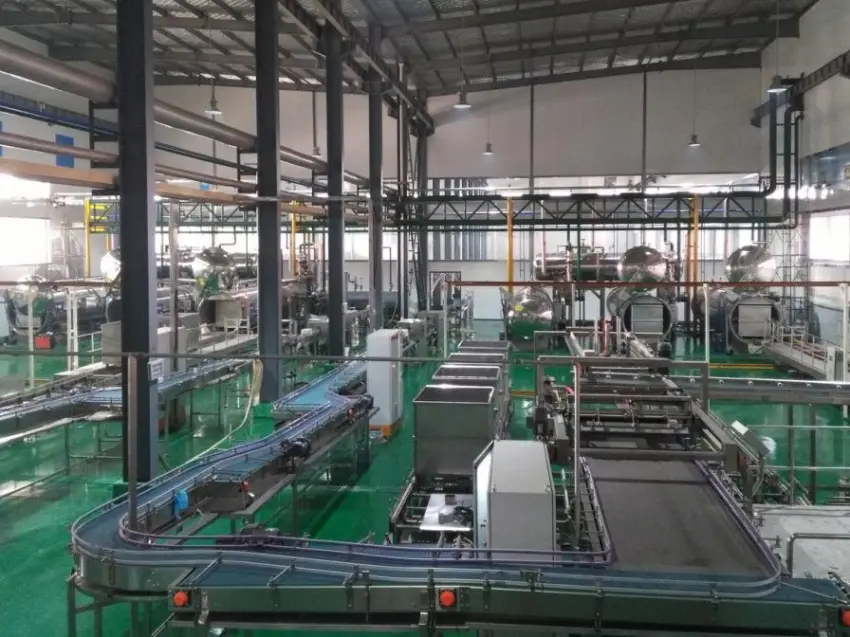
A high-quality retort autoclave is a pressure vessel engineered to hit a target lethality (F0 value) consistently, batch after batch, without leaking, corroding, or drifting out of calibration. Two vessels with identical dimensions can perform very differently depending on steel grade, welding quality, and control system precision.
In practice, quality shows up in three places: the pressure vessel certification, the process control accuracy, and the mechanical components that wear out first (seals, rollers, valves). Buyers who only compare price per unit often miss all three.
Pressure Vessel Standards You Should Ask About
Any reputable manufacturer should be designing and building to a named pressure vessel code. In China, that’s typically GB150-2011 (Steel Pressure Vessels). In the US and EU, ASME Section VIII or the Pressure Equipment Directive (PED) apply.
– Ask for the specific code and edition used in the design calculation.
– Request material certificates (mill test reports) for the shell and heads, not just a datasheet.
– Confirm the vessel carries a GMP-compliant interior finish and, if you export to the US, FDA-aligned documentation.
A vessel manufactured to GB150-2011 with GMP and FDA-aligned documentation, for example, gives a purchasing manager a paper trail to hand to their own quality auditors — something a no-name fabricator usually cannot provide.
Rotary vs. Static Retort Autoclaves: Which Fits Your Product Line?
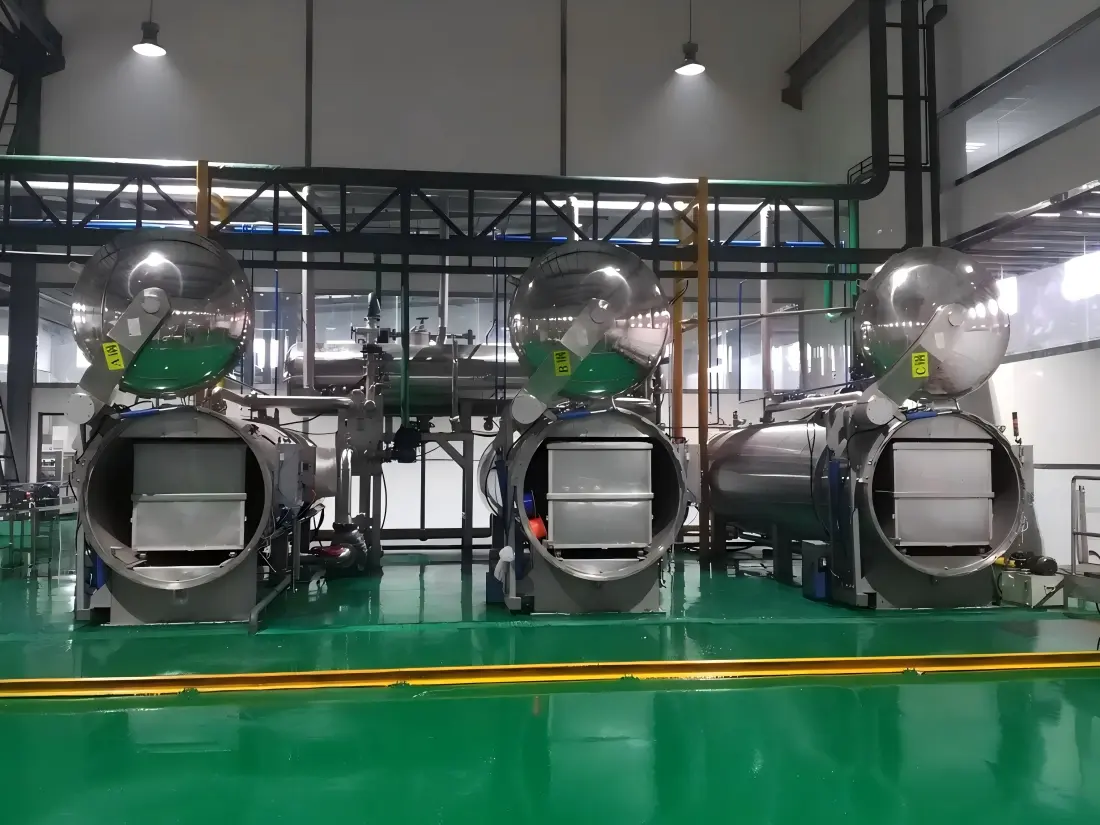
Rotary retorts spin the product basket during the cook to improve heat penetration in liquid-heavy products; static retorts hold the load still and are simpler but slower for viscous foods. The right choice depends on your packaging format and product viscosity.
| Factor | Steam Static Retort | Steam Rotary Retort | Water Immersion Rotary Retort |
|---|---|---|---|
| Best for | Rigid metal cans, glass jars | Canned porridge, congee, condensed milk | PP bottles, HDPE bottles, bowls, gas-retaining pouches |
| Heat transfer medium | Saturated steam | Saturated steam | Hot water (temperature/pressure independently controlled) |
| Counter-pressure flexibility | Limited | Limited | High — can add or bleed pressure to match internal package pressure |
| Typical cycle improvement | Baseline | 15–30% faster than static | Comparable to steam rotary, gentler on flexible packaging |
| Package damage risk (flexible containers) | Moderate-high | Moderate | Low, due to independent pressure control |
If your line runs PP bowls or gas-containing packaging, a water-based rotary system with independent temperature/pressure control is usually the safer choice — this is the approach Matton’s rotary retort line is built around, precisely because saturated steam’s fixed temperature-pressure relationship doesn’t give you that flexibility.
Key Engineering Features to Check Before You Buy
Beyond the vessel code, several mechanical and control details separate a retort that runs reliably for a decade from one that generates constant service calls.
Temperature and Pressure Control Accuracy
Ask the supplier for their control tolerance in writing, not verbally. Equipment worth buying should hold temperature within roughly ±0.2°C and pressure within roughly ±0.01 MPa across a full cycle — tighter tolerances translate directly into a more predictable F0 value and fewer borderline batches.
– Dual Class-A PT100 sensors (full-scale accuracy of about 0.3°C) with a backup mercury glass thermometer are a reasonable minimum for redundancy.
– A PLC (Siemens is common in this segment) that can store dozens to hundreds of sterilization recipes reduces operator error on multi-SKU lines.
– Multi-level password protection — separating QC, engineering, and operator permissions — stops a single unauthorized change to a validated cook cycle.
Roller and Support System (Rotary Units Only)
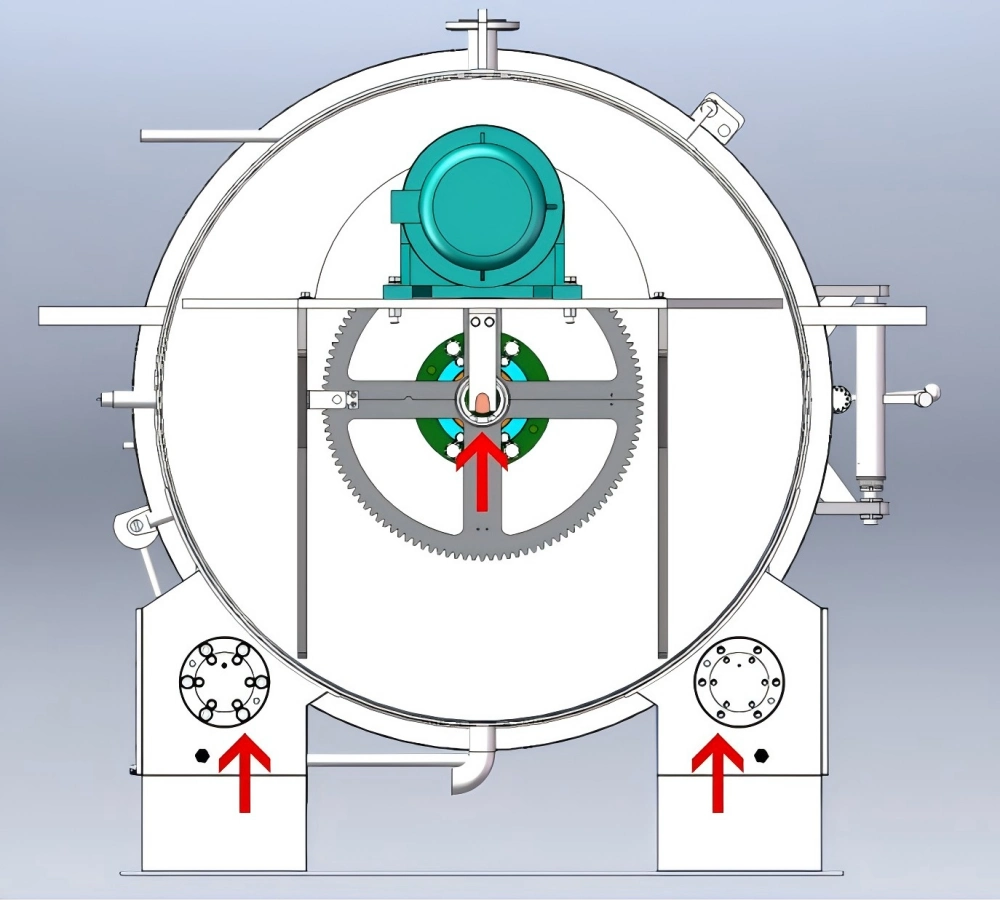
This is where cheaper rotary retorts fail first. If the support rollers and their bearings sit inside the water-filled shell, they’re constantly wet, corrode faster, and are difficult to reach for maintenance without draining and pulling the whole rotating cage.
In our field observations, rotary retorts with external roller bearings — mounted outside the seal, using spherical roller bearings rated for heavy, low-speed loads — need servicing roughly every three months instead of monthly, and typically last two or more years before replacement. A three-point support (rear shaft plus rollers) also holds better concentricity than a four-point layout, which matters for even heat distribution during rotation.
Heat Exchanger Technology: Plate vs. Spiral Wound Tube
This is the single biggest hidden cost we see purchasing managers overlook. Plate heat exchangers are cheaper to buy but expensive to run.
| Cost Factor | Plate Heat Exchanger | Spiral Wound Tube Heat Exchanger |
|---|---|---|
| Required footprint (example: DN1600×6300 retort) | ~37 m² | ~21 m² |
| Gasket lifespan under 0.5–0.6 MPa steam | ~6 months | Not applicable (gasket-free) |
| Annual gasket replacement cost (1 unit, 2 changes/year) | ~¥8,000 | ¥0 |
| Labor cost per replacement (3 people, 2 days) | ~¥900/year | ¥0 |
| Circulation pump power (comparable flow) | ~22 kW | ~15 kW |
| Estimated annual electricity savings | Baseline | ~¥28,000 (200 working days/year) |
| Maintenance access | Requires full shutdown, forklift often can’t reach the unit | Cleans in place, no disassembly needed |
Add the direct gasket and labor costs to the electricity difference, and a spiral wound tube exchanger can save a single-retort plant on the order of ¥30,000+ per year — before counting the production downtime avoided by not having to schedule an emergency gasket swap. Matton’s rotary retort line uses this spiral wound design specifically to cut both footprint and the recurring maintenance burden that plate exchangers create.
Safety Systems You Should Never Skip
– Door interlock: sterilization cannot start unless the door is fully sealed, and the door cannot open until pressure is released.
– Adjustable safety relief valve that opens automatically above the set pressure.
– Independent pressure sensor and gauge, plus a manual pressure-relief valve on the door as a physical backup.
– Audible/visual alarms for temperature and pressure excursions, logged automatically for QC review.
How to Evaluate a Retort Autoclave Factory (Not Just the Product Sheet)
A brochure can claim anything. The manufacturing process tells you whether the vessel will still be round, leak-free, and stress-crack-free after five years of daily heat cycling.
Walk through — or ask for photos/video of — these steps:
1. Shell rolling: Look for CNC hydraulic plate rolling with roundness deviation under about 2mm; uneven rolling concentrates stress and shortens fatigue life under repeated heating and cooling.
2. Head forming: A single cold-press-formed head, followed by vibration aging (stress relief), resists deformation better than multi-piece welded heads.
3. Door flange forging: Two-piece forged flanges, individually machined on CNC equipment, then vibration-aged, reduce the risk of cracking from residual stress release.
4. Welding quality: Ask whether the shop uses plasma welding centers and laser cutting for dimensional consistency, versus manual cutting and fitting.
5. Interior surface treatment: Sandblasted stainless steel interiors resist corrosion better — particularly from the chlorine commonly added to cooling water — than a mill-finish or polished-only surface.
Real-World Buying Mistakes We See Repeatedly
After years of specifying and troubleshooting this equipment, a few patterns keep showing up on plant floors:
– Buying on price per liter of vessel volume alone. Two retorts of the same size can differ by 20%+ in lifetime operating cost once heat exchanger and roller maintenance are included.
– Skipping the counter-pressure question for flexible packaging. Plants running PP bowls or pouches without independent water-based pressure control see higher package deformation rates during trial runs.
– Assuming any PLC is equivalent. A control system without multi-level permissions lets any operator alter a validated cook cycle — this is a food safety audit finding waiting to happen.
– Ignoring bearing placement on rotary units.** Submerged bearings look identical to external ones in a sales photo but fail on a completely different maintenance schedule.
Choosing Between Suppliers: A Practical Checklist
When comparing quotes from two or more retort autoclave factories, request the following in writing before signing:
- Pressure vessel code and certificate (GB150-2011, ASME, or equivalent)
- GMP/FDA compliance documentation
- Control tolerance (temperature and pressure) with supporting test data
- Heat exchanger type, size, and expected annual maintenance cost
- Roller/bearing configuration for rotary units (internal vs. external)
- Shell material grade (e.g., S30408/06Cr19Ni10 stainless for water-contact piping) and mill certificates
- Warranty terms on the PLC, valves, and bearings specifically — not just the vessel shell
Suppliers who hesitate to provide this list item by item are usually the ones whose equipment underperforms once installed.
Frequently Asked Questions
What pressure and temperature can a standard rotary retort autoclave handle?
Most commercial rotary retort autoclaves are rated for a maximum working pressure around 3.0 bar and a maximum working temperature around 150°C, though the exact rating depends on the vessel’s design code and intended product line. Always confirm the specific rating against your process requirements before ordering.
How often should retort autoclave rollers and bearings be serviced?
For products like canned congee, condensed milk, or PP-packaged foods, yes — rotation improves heat penetration and can shorten cycle times by roughly 15–30% compared to static retorts, which usually offsets the price difference within one to two years of production volume.
How often should retort autoclave rollers and bearings be serviced?
It depends on the design. Units with bearings submerged inside the water-filled shell often need attention monthly, while units with external, spherical roller bearings outside the seal typically only need servicing about every three months and last two or more years before replacement.
Can one retort autoclave handle both canned products and plastic bottles/bowls?
A multi-purpose water-based rotary retort with independent temperature and pressure control can process both metal cans and flexible plastic packaging in the same vessel, which is useful for plants running mixed product lines without buying separate machines for each format.
Find the right retort solution for your production line today.
When selecting a retort supplier, the ultimate test is not the specifications listed in a brochure, but whether the equipment can run reliably for a decade after installation. Factors such as pressure vessel certification, trunnion bearing configuration, and heat exchanger selection—all mentioned earlier—are critical determinants of long-term operating costs. These details often only become apparent after the equipment is installed, at which point the cost of replacement is already prohibitively high.
If you are selecting sterilization equipment for canned fruit, PP-bowl packaged products, milk and beverages, or meat products, we invite you to submit an inquiry now to receive personalized process recommendations and a price quote. Whether you are a small-to-medium-sized food processing plant making your first purchase or a large enterprise evaluating an equipment upgrade, we can provide comprehensive recommendations tailored to your specific production line—covering everything from pressure vessel design and rotary mechanism selection to control system configuration.